How we cost, so the number holds.
A profitability model is only as good as the method under it. These are the costing methods and management frameworks we build on, chosen so every number stays traceable and defensible.
TDABC vs ABC
Why time-driven activity-based costing is faster and more durable.
Read →MethodThe Cost of AI
The unit cost and profitability of AI, measured with TDABC.
Read →MethodCosting Maturity Model
How mature is your costing, from blind bookkeeping to predictive.
Read →MethodSustainability and Cost
Activity-based carbon accounting and the marginal cost of abatement.
Read →MethodPlanning and Budgeting
Strategy, budgeting and forecasting built on a causal cost model.
Read →MethodZero-based Budgeting
Justify every euro from zero, against true activity costs.
Read →MethodCapacity Costing
Practical capacity and the cost of unused capacity, the base of TDABC.
Read →MethodAI Profitability
AI for speed, TDABC for logic, a full trail for trust.
Read →MethodValue-Based Health Care
True cost per patient pathway, the backbone of VBHC.
Read →MethodIFRS & Cost Accounting
From IAS 2 and IFRS 8 to IFRS 18, compliance that also informs.
Read →FrameworkBalanced Scorecard + TDABC
Connect strategy to the true cost of executing it.
Read →FrameworkLean & Six Sigma + TDABC
Cost the waste, so improvement targets the expensive work.
Read →FrameworkStrategy Execution + TDABC
Resource the plan against what each initiative really costs.
Read →- Absorption vs Variable (Direct) Costing
- Activity-based costing: the method that revealed hidden cost
- Activity-Based Management (ABM)
- BI Tools for Cost and Profitability Analysis
- Capital Allocation, ROIC and the Cost of Capital
- Channel and Segment Profitability Analysis
- From First Contact to a Live, Trusted Profitability Model
- Cost-to-Serve in Commercial Due Diligence
- Cost of Quality (COQ and COPQ)
- The Cost of Unused Capacity
- Cost-Volume-Profit (CVP) and Break-Even Analysis
- Eleven Costing Methods Compared in One Table
- CostCtrl vs Spreadsheets for Profitability Modelling
- Customer Lifetime Value (CLV) in Profitability Analysis
- Driver-Based Planning and Rolling Forecasts
- Economic Value Added (EVA) and Residual Income
- Enterprise Costing, Then vs Now
- ETL for Cost and Profitability Analytics
- From Blueprint to a Model That Runs: Closing the Implementation Gap
- GPK (Grenzplankostenrechnung): German marginal planned cost accounting
- Job Costing vs Process Costing
- Kaizen Costing and Continuous Cost Improvement
- Life-Cycle Costing and Total Cost of Ownership
- Make-or-Buy and Relevant Costs
- Management Accounting vs Financial Accounting
- Pocket Price Waterfall and Price Realization
- Portfolio-Company Profitability Diagnostics for Private Equity
- Sales Mix and Product-Mix Optimization
- Enterprise-Grade Profitability for SMEs, Without Big-4 Budgets
- Profitability KPIs and Performance Measurement
- Profitability OKRs: Making Financial Key Results Measurable
- Resource Consumption Accounting (RCA)
- Standard costing: predetermined costs and variance analysis
- Target costing
- The costing model that died (and how to keep yours alive)
- Throughput accounting
- Time-driven activity-based costing: ABC made simple and scalable
- Transfer Pricing for Internal Profitability
- UEP: the production effort unit method
- Why Costing Models Fail After Go-Live
Each method answers one kind of question well and others badly. One line on where each fits, and where it does not.
Absorption vs variable costing
Absorption costing values inventory in the financial statements (IAS 2); variable costing is the one to use for special orders, short-term pricing and break-even, because absorption unit cost treats fixed cost as if it moved with volume.
Cost-volume-profit and break-even
Good for testing how profit moves with price, volume and a stable mix; misleading when many products carry very different support costs, because one contribution ratio averages them away.
Standard costing
Fits repetitive production where material and labour dominate and a monthly variance report drives action; it loses its grip when products change often or overhead is most of the cost.
Job costing vs process costing
Job costing for made-to-order work you can trace job by job, process costing for continuous, uniform output averaged over a period; plants that do both need both.
Activity-based costing (ABC)
Use it when overhead is large and products, customers or channels consume support very differently; avoid it if the staff survey behind it cannot be repeated, which is where most ABC models stalled.
Time-driven ABC (TDABC)
Use it for cost per order, customer or service line that must be refreshed monthly from operational data; it needs a capacity cost rate per department and time estimates per activity, so start with one process if those are missing.
Throughput accounting
The right lens when one bottleneck limits output and the question is what to run through it this month; it says little about long-run product or customer profitability, because it treats almost every cost as fixed.
Target costing
Works at design stage: market price minus required margin gives the cost the product must be engineered to; once the product is in production, kaizen costing takes over.
Life-cycle costing and TCO
For equipment, fleets, software and products whose running and disposal costs outweigh the purchase price; discount the future costs, or late costs weigh as much as early ones.
Make-or-buy and relevant costs
For outsourcing and insourcing decisions, compare only the costs that change between the options; allocated overhead that stays whatever you decide is the most common error.
Cost of unused capacity
Belongs in any rate per hour or per unit: costing at practical capacity separates the cost of work done from the cost of idle capacity, so a quiet month does not make every product look dearer.
Economic value added (EVA)
Judges whether a business unit earns more than its cost of capital; it is a measure for units and divisions, not for single products or customers, unless capital can be traced to them.
All eleven, side by side
The comparison table scores eleven costing methods on the same six criteria: accuracy, effort to build, effort to maintain, data needed, fit and limits.
Start from the decision, not from the method. Five questions settle most cases.
Is the number for the financial statements or for a decision?
Inventory in the accounts is valued at full production cost. Pricing, mix and customer decisions need one of the methods above, reconciled to the same total cost.
Is the decision short term, with capacity fixed?
Variable costing and cost-volume-profit. If a single resource is the constraint, throughput accounting.
Do products, customers or channels consume support very differently?
Activity-based costing, or time-driven ABC if the model has to be refreshed every month without a new survey.
Is the product still on the drawing board?
Target costing during design, then kaizen costing once it is made.
Is the question to make, buy, keep or drop?
Relevant costs, with the cost of unused capacity shown on its own line, so that capacity freed by a decision is not counted as a saving until it is actually removed or reused.
Most companies end up with two layers: absorption costing for the accounts and an activity-based or time-driven model for decisions. Both must add up to the same total cost; when they do not, neither is trusted.
Want the method on your data?
The Profit Check takes 10 minutes and shows where a proper cost method would pay.
- Duration
- 10 minutes
- You receive
- Score, 7 dimensions, sector benchmark
- We ask for
- Name, organisation, work email, industry, size
Proof
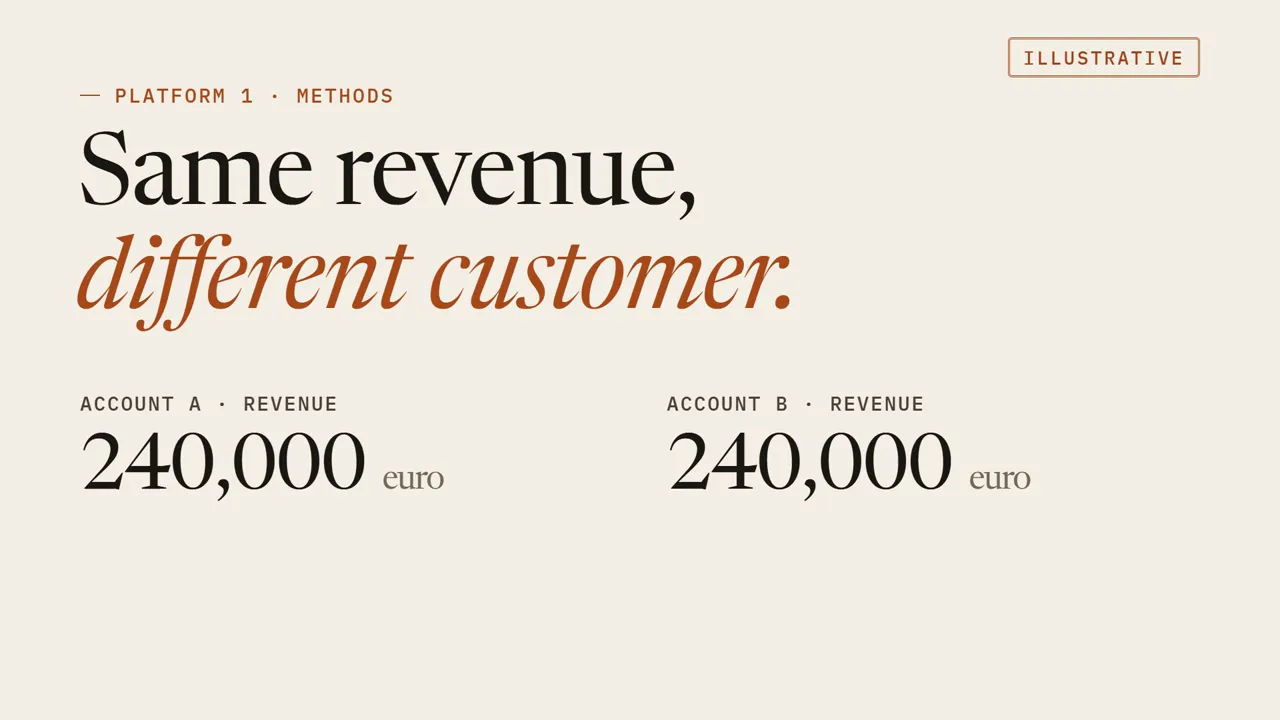
A distributor in New Zealand. €1.335M of cost-to-serve made visible, then halved, and 830 loss-making customers brought down to 295.
Read the case study →Who you would be talking to
Miguel Guimarães, Founding Partner
Cost and profitability practitioner for 25+ years. Presented the Damco cost-to-serve case at Managing for Profit (Amsterdam RAI, December 2009), on the same programme as Robert S. Kaplan.
Call +351 910 313 731