Textbooks introduce cost object, cost pool, cost driver and activity from left to right: resources are gathered into pools, pools flow to activities, activities flow to products. That is the order in which cost moves through a model. It is not the order in which a model should be designed, and most of the confusion between the four words comes from learning them in the wrong order. When I build a model I start at the right-hand end, with the thing whose cost somebody needs for a decision, and work backwards. Pools are the last thing I define, not the first. Read in that order, the four words stop overlapping, because each one answers a different question at a different moment of the design.
Start with the cost object, because it is the question
A cost object is whatever you want a separate cost for. The US Federal Acquisition Regulation, which has to be precise because contracts are paid on it, calls it a “cost objective” and defines it as a function, organisational subdivision, contract or other work unit for which cost data are desired. The key word is desired. The cost object is chosen by the question, not found in the ledger.
The choice decides what the model can see. In the New Zealand distributor case published on this site, the cost object was the customer, and the first model showed that 830 of the distributor’s 1,951 customers were contributing negatively once the cost of serving them was attributed, a combined €1.335M. The commercial decisions that followed were taken one level finer, on product-and-customer combinations: repricing where the economics did not work, and consolidating many small orders into fewer larger ones. A model whose only cost object was the product would have spread that €1.335M across the product range as a slightly higher overhead rate, and the loss-making relationships would not have appeared as a group at all. Same ledger, same activities. A different cost object, and a different set of decisions becomes possible.
So the first design question is not “what are our cost pools?” but “which decision will this number support?” If the answer is pricing by customer, the customer has to be a cost object. If it is a make-or-buy decision on a component, the component does. Most useful models end up with more than one, because the same order line carries a product, a customer and a channel.
Then the activities, named with a verb
Once the cost object is fixed, the next question is what work the organisation does for it. An activity is that work, and the discipline that keeps it honest is to name it with a verb and a noun: picking an order, packing a parcel, handling a return, answering a support call. The distributor’s case page lists exactly this kind of work as the cost that varied from customer to customer: the picking, the packing, the shipping, the support.
The test that catches most errors here is simple. If an activity is named with a noun alone, “Warehouse”, “Finance”, “Customer service”, it is a department, not an activity. A department can be a pool. Inside it there are usually several activities that are consumed in different proportions by different cost objects, and the whole point of naming them separately is that they will be given different drivers. A model whose activities are all department names is a departmental overhead model with an activity-based label on it.
Then the drivers, and there are two kinds
A driver is the measure that carries cost along an arrow in proportion to how much of the work each recipient caused. Two different arrows need two different kinds of driver, and many textbooks name only one of them.
A resource driver takes cost from a pool to an activity: the share of the warehouse team’s time spent picking rather than packing, the floor area used by the returns bench. An activity driver takes cost from an activity to a cost object: order lines picked, parcels packed, returns handled. The resource driver is usually estimated once and revisited; the activity driver is counted every period from transaction data.
How good does a driver have to be? The US Cost Accounting Standards give an order of preference that I find more useful than most textbook advice. Standard 418 says an indirect pool should be allocated by a measure of the resources consumed where one is available; failing that, by a measure of output; and only when neither can be measured practically, by a surrogate that varies in proportion to the services received. Order lines picked is a consumption measure for a picking activity. Revenue is a surrogate for almost everything. Cooper and Kaplan warned in 1988 that managers often take pricing and product-mix decisions on distorted cost information, and rarely have other data that would show them the costs are wrong.
One practical check: a driver has a unit you can count. “Machining” is not a driver; machine hours is. “Customer complexity” is not a driver; order lines per order is.
The cost pool comes last
Only now does it make sense to decide how ledger costs are grouped. Standard 418 defines an indirect cost pool as a grouping of incurred costs identified with two or more cost objectives but not specifically with any final one, and it adds the condition that matters in practice: for a pool to be homogeneous, each significant activity inside it should have the same or a similar causal or beneficial relationship to the cost objects. In plain terms, a pool is a set of costs that can sensibly be divided by one driver.
That condition gives two quick tests. A pool with a single ledger account in it usually means nobody asked which costs are consumed together. A pool so broad that one driver cannot describe how all of it is consumed is the opposite failure: wages and forklift depreciation in one pool, divided by headcount, charges the forklifts to whichever team has the most people. Designing pools after activities and drivers avoids both, because by then you know which driver each group of costs will be divided by, and the pools fall out of that. How many to have is a separate question, which I have written about in how many cost pools is too many.
An illustrative warehouse, worked through
The figures in this section are illustrative, chosen to show the mechanics. They do not come from a client.
A distribution warehouse costs €760,000 a year in wages, forklift and racking depreciation, energy and packaging. Two customers are being compared, and they are the cost objects. Three activities do the work: picking order lines, packing parcels and handling returns. A two-week time study says the warehouse team spends about 70 percent of its time picking, 20 percent packing and 10 percent on returns, so the resource driver sends €532,000 to picking, €152,000 to packing and €76,000 to returns.
The activity drivers come from the warehouse system. The year saw 380,000 order lines picked, 47,500 parcels packed and 1,900 returns handled, which gives rates of €1.40 per line, €3.20 per parcel and €40.00 per return.
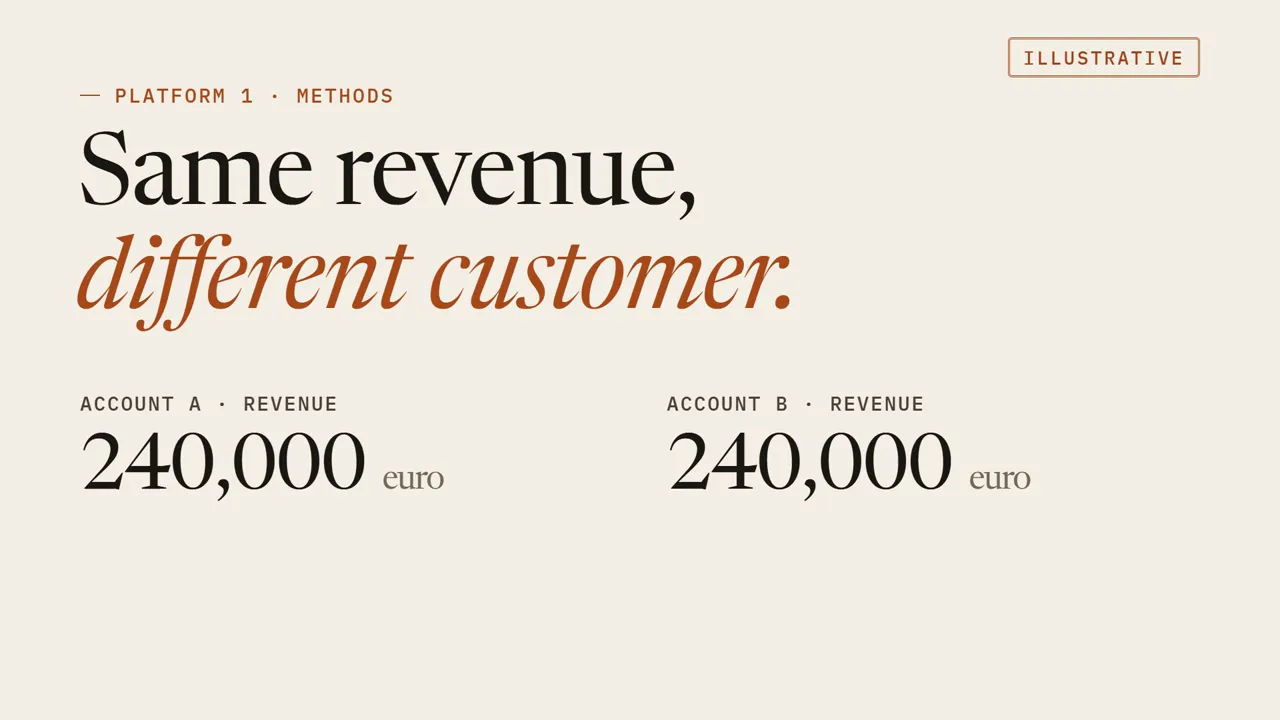
Customer P orders little and often: 1,200 orders a year of three lines each, each shipped as its own parcel, with 60 returns. Customer Q orders 150 times a year with 24 lines per order and returns almost nothing, 3 in the year. Both take exactly 3,600 lines.
| Customer P | Customer Q | |
|---|---|---|
| Picking: 3,600 lines at €1.40 | €5,040 | €5,040 |
| Packing: parcels at €3.20 | 1,200 parcels, €3,840 | 150 parcels, €480 |
| Returns at €40.00 | 60 returns, €2,400 | 3 returns, €120 |
| Warehouse cost, three activities | €11,280 | €5,640 |
| Warehouse cost, one pool divided by lines (€2.00 a line) | €7,200 | €7,200 |
With one pool and one driver, the two customers cost the same, because they take the same number of lines. Split into three activities with their own drivers, P costs twice as much as Q. The single-driver version understates P by €4,080 and overstates Q by €1,560. Nothing in the ledger changed between the two rows; only the activities and the drivers did. And the reason it matters at all is the first decision: the customer was chosen as the cost object.
What time-driven ABC changes in the four words
Time-driven activity-based costing, as Kaplan and Anderson set it out in 2004, keeps all four words and removes one step. The resource driver, the time study that split the warehouse 70, 20 and 10, is replaced by a capacity cost rate: the cost of the warehouse team divided by the minutes it can practically supply. Each activity is then described by how many minutes it takes, so the activity driver is time by construction. The authors present this as a response to the cost and employee irritation of large interview-based ABC models, relying on informed managerial estimates rather than surveys. The cost object does not change at all, which is why a model built on the four words in the right order can usually be rebuilt as time-driven without changing what it measures.
The four definitions, short enough to quote
Cost object: the thing you want a separate cost for, chosen by the decision the number will support: a product, a customer, an order, a contract, a patient episode.
Activity: a unit of work the organisation performs, named with a verb and a noun, such as picking an order line. A department is not an activity.
Cost driver: the countable measure that carries cost along an arrow. A resource driver moves cost from a pool to an activity; an activity driver moves cost from an activity to a cost object.
Cost pool: a group of ledger costs that are consumed in the same way and can sensibly be divided by one driver.
Sources
- Federal Acquisition Regulation, 48 CFR 31.001, definitions of “allocate” and “cost objective”. acquisition.gov/far/31.001
- Cost Accounting Standard 418, Allocation of direct and indirect costs, 48 CFR 9904.418-30 (definitions, including indirect cost pool). law.cornell.edu
- Cost Accounting Standard 418, fundamental requirement, 48 CFR 9904.418-50 (homogeneous pools; consumption, output and surrogate bases). law.cornell.edu
- Robin Cooper and Robert S. Kaplan, “Measure Costs Right: Make the Right Decisions”, Harvard Business Review, September 1988. hbr.org
- Robert S. Kaplan and Steven R. Anderson, “Time-Driven Activity-Based Costing”, Harvard Business Review, November 2004. hbr.org
Related reading: cost pool, cost driver, activity and resource in the glossary, how to choose a cost driver, the cost driver library, Cooper’s cost hierarchy, worked through and TDABC versus ABC.